
Mail Correspondence with Soldiers at War (“Feldpostbriefe”): “When you receive this letter” by Lilo Weinsheimer (Published on 03/12/2022, latest revision on 06/04/2026)
I. The Care of War Victims
Anyone who wants to understand what war means and what its consequences are will often find unvarnished accounts in the reports of doctors and nurses from military hospitals. It was to them that the wounded were sent for treatment; they were confronted with pain, suffering, and death every day, and the images associated with these experiences often haunted them for the rest of their lives.
II. “When You Receive This Letter” by Lilo Weinsheimer
A particularly powerful account comes from the German journalist Lilo Weinsheimer, who in 1960, in a piece titled “When You Receive This Letter,” wrote about the experiences and feelings of a German military nurse in the form of an apparently fictional letter.
II. “Wenn Ihr diesen Brief bekommt” (“When you receive this letter”) by Lilo Weinsheimer
A particularly powerful account comes from the German journalist Lilo Weinsheimer, who in 1960, in a piece titled “When You Receive This Letter,” wrote about the experiences and feelings of a German military nurse in the form of an apparently fictional letter.
She wrote (Source: Volksbund Deutsche Kriegsgräberfürsorge, Erzählen ist Erinnern [1999], S. 33 [translation from German language]):
“My name is Barbara. Formerly Nurse Barbara. That was when I saw them die. Those whose names were written with white chalk on boards at the head of the iron beds. Private, it said, or rifleman, soldier, lieutenant, grenadier. Sometimes there was not enough time to hang up the boards because something tattered and nameless had died first. This was entered in a large book. As a departure. The serial number was a four-digit number. Sometimes, when there was no end to the iron whirl outside, one leaned one’s head against a wall for two breaths and thought: »I can’t go on«. Then it would call out from a bed, »Nurse«. Sometimes one squatted on the edge of a bed or on the floor and wrote on a scrap of paper what the voice of the dying person dictated: »Dear parents, if you get this letter«, or: »My dear wife and dear children«.
Sometimes you read printed paper that said war was sacred, dying was beautiful. Once you couldn’t read any further because someone had torn the bandage off his head and was screaming. When you had a few days’ leave, you went home. There you were supposed to tell your story and suddenly you didn’t know anything and couldn’t find a word that would have fit. In the evening, when no one saw it, you caressed a book, a music book, a picture. You would have liked to open a book in which there were poems. But you couldn’t. Once you suddenly remembered: I am twenty years old. You put on your best dress and wanted to have some fun.
But when you tried to put the horror away, the fear, the dying, the white faces, the hacking beat of the boots in the nights – when you wanted to forget it for once, as if in a fever, it was closer than ever before. That’s when you knew you’d drag it with you wherever you went, and felt hungry, burnt-out eyes.
Then you went out into the forest. It smelled like freshly cut wood. The white mist came, and then the stars were there. You stayed outside and put your head where the earth has its heart. Once in the military hospital you sat with one who had burning fever eyes and always said Hanna. For fifteen hours your name was Hanna. Then he was dead. You wrote a letter to Hanna. Later you met her and told her about her husband’s dying. She was 19 years old and was pregnant.
Once you rode for eight and a half hours in a barred carriage with one who was tied to his stretcher, whose head was in blood-soaked cloths, who laughed behind these cloths for eight and a half hours. You wrote on a sheet of paper to a person who did not exist: »Being left over is the worst. We are left over many times every day for years.«
Once you asked one who wore sparkling boots, golden strings on his cap, and walked from one bed to another, »Why do you let this happen, you great, wise, powerful ones? Why don’t you help?« His curious face turned sallow. »Nerves«, he then said, smiling icily. »You need to take a break, my child.« That’s when you felt ashamed for mistaking a uniform for a human being.
And once, you could no longer be still and composed. When you felt the enormity, that it was a frenzy in which the individual almost no longer counted; that you were almost already used to it; that you no longer had strength enough to give every dying a thought and to love every breathing world that passed away as if it were one’s own. Then you asked so desperately, as you had asked nothing in life so far: To remain awake, able to recognize the terrible as terrible, saved from seeing and accepting what piles up as senseless madness and wants to make senseless.
Today I know that this was a prayer for life and death.”
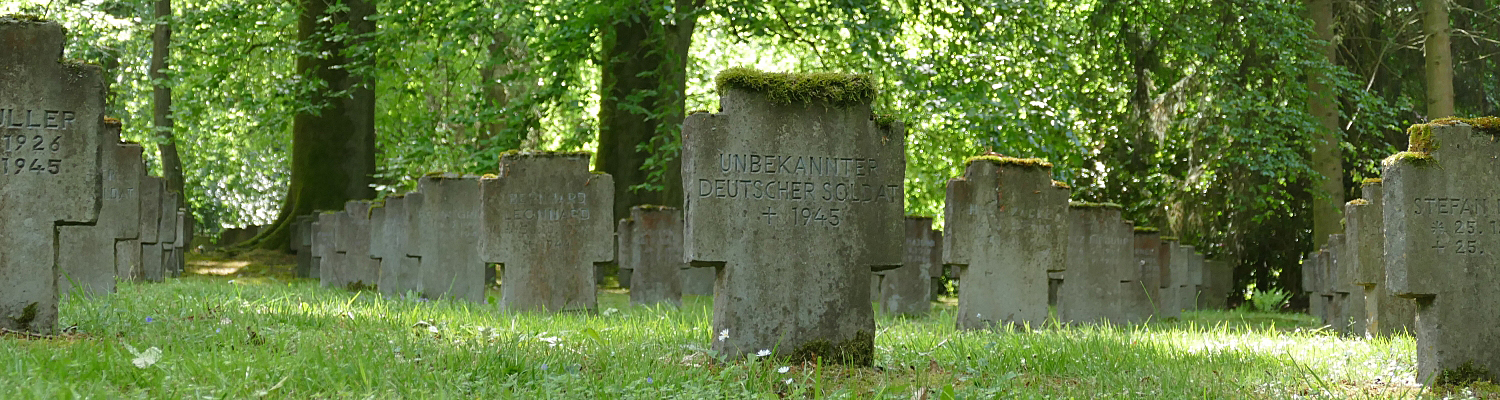
(Head picture: Forest cemetery Aachen, May 2022)
If you wish to support my work, you can do so here. Many thanks!